The Relationship Life Cycle™ Framework
Relationships have seasons. This is the map.
Every relationship has different needs at different points in its journey. The Relationship Life Cycle™ gives you the context to understand where you are — and what comes next.
We don't have a shortage of relationship advice.
We're surrounded by conversations about communication, attachment, trust, conflict, boundaries, dating, marriage, divorce, healing, and countless other relationship topics. Most of it is useful. Most of it is true.
The problem isn't that the advice is wrong. The problem is that it's often taught in isolation — as though each relationship challenge exists independently from the larger journey.
A couple struggling with conflict doesn't necessarily have a conflict problem. They may have never built the foundation that allows them to navigate conflict together. A person who keeps choosing the wrong partners may not need dating advice. They may need a clearer understanding of what the early stages of a relationship are actually supposed to accomplish.
The Relationship Life Cycle™ was created to provide the context that makes everything else make more sense.
What is the Relationship Life Cycle™?
The Relationship Life Cycle™ is a developmental framework for understanding how relationships grow, change, and evolve over time.
It's built on a simple but powerful idea: relationships are not static. They develop. The needs of a relationship in its earliest stages are not the same as its needs five years later. The skills required after a breakup are different from those needed at the beginning of a new relationship.
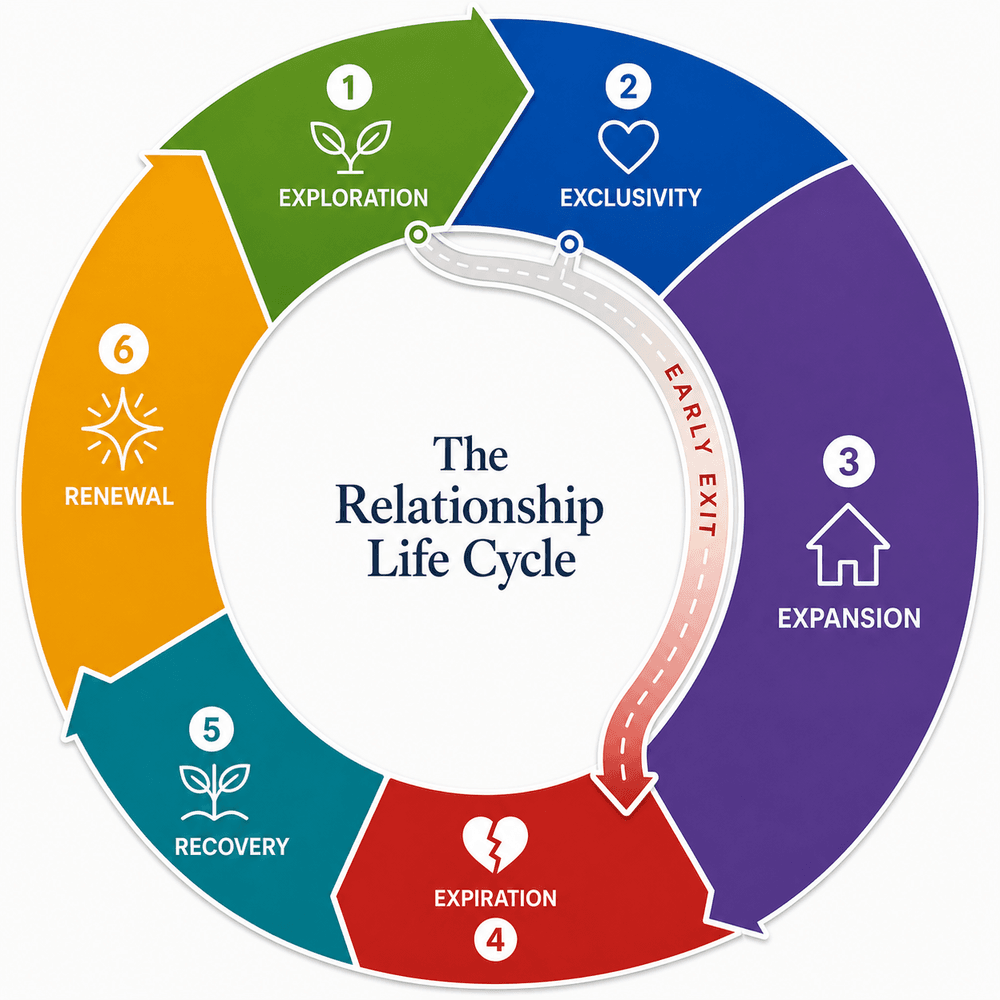
Most relationship advice treats these as separate conversations. The Relationship Life Cycle™ brings them together into one developmental framework — organized around six phases, six universal areas of focus, and the idea that every phase serves a specific purpose in the larger journey.
Why developmental context changes everything.
After years of clinical practice, a pattern became impossible to ignore. The resentment, the distance, the feeling that couples had somehow failed each other — it rarely started where they thought it did.
Most of the time, the relationship had simply outpaced itself. They'd moved forward without building what they needed to carry them through. Not because they didn't love each other. Because nobody ever showed them what that foundation was supposed to look like — or when they needed to build it.
Sometimes the challenge isn't the relationship. It's trying to solve today's problems with yesterday's expectations — or tomorrow's expectations applied too soon.
The Relationship Life Cycle™ gives people the map they were never given.
“Every relationship has different needs at different points in its journey. The first step is understanding where you are.”
How the framework works.
Relationships develop over time.
Every relationship moves through recognizable phases, each with its own purpose, focus, and opportunities for growth.
Every phase has a primary focus.
The work of one phase is not the same as the work of another. Understanding the difference is where growth begins.
Context changes everything.
Good advice applied at the wrong stage can create more confusion than clarity. The framework helps you apply the right tools at the right time.
The framework is a map, not a judgment.
It doesn't tell you where you should be — it helps you understand where you are.
Every phase serves a purpose.
Even the hardest phases — expiration, recovery, renewal — are not failures. They are part of the developmental journey.
The six phases of the Relationship Life Cycle™
Each phase has a distinct purpose, a primary focus, and a set of skills and experiences associated with healthy progression.
Six areas. Every phase.
Every relationship expresses itself through six key areas — communication, trust, emotional connection, how conflict is handled, how responsibilities are shared, and physical intimacy. These areas are present throughout every phase of the relationship. But what they look like — and what they require — changes as the relationship develops.
Communication
The primary mechanism through which partners exchange information, construct shared meaning, and navigate each developmental phase.
Trust
The degree to which partners demonstrate reliability, honesty, accountability, and emotional safety over time.
Emotional Intimacy
The depth of emotional connection, vulnerability, and mutual understanding between partners.
Conflict Management
The ability to navigate disagreement constructively, repair relational ruptures, and use conflict as a source of growth.
Role Functioning
How well partners coordinate shared responsibilities, expectations, and roles within the relationship.
Physical Intimacy
The presence, quality, and communication surrounding physical connection and affection.
“Spring is not better than winter. Summer is not more important than autumn. Each season serves a different purpose. Every phase of relationship development serves a different purpose.”